
Crowns and Bridges in Fairfax, VA
We design dental crowns and bridges as precision-crafted restorations.
Dental Crowns in Fairfax, VA
At our Fairfax, VA practice, dental crowns—often called caps—are custom-crafted restorations designed to breathe new life into teeth that have been compromised by injury, decay, or wear.
Using high-grade materials such as porcelain, ceramic, or durable metal alloys, each crown is meticulously tailored to fit your tooth with precision, acting as a protective shield while restoring its natural contour and luster.
Beyond just reinforcement, these restorations give you the freedom to eat, speak, and smile with renewed assurance—whether we’re fortifying a cracked tooth, completing a bridge, or anchoring an implant, our goal is always to preserve your natural structure while elevating both function and beauty.
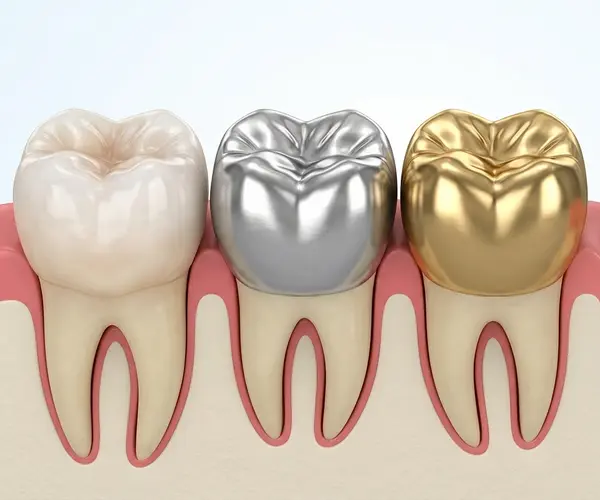
Types of Dental Crowns
Porcelain Crowns
Crafted from dental-grade ceramics, porcelain crowns are prized for their extraordinary aesthetic appeal. Engineered to replicate the natural translucence and color gradients of real tooth enamel, they blend seamlessly into your smile—especially in prominent areas like the front teeth where first impressions count. However, their beauty comes with a practical trade-off: while visually superior, porcelain is less resilient than metal alternatives and may chip or crack under intense biting forces, so they’re best suited for patients mindful of their chewing habits.
Metal Crowns
Constructed from premium metallic substrates—including gold alloys, palladium-based compounds, and high-performance base metals—metal crowns are distinguished by their extraordinary tensile strength, resistance to occlusal wear, and long-term clinical reliability. Their minimal-prep design preserves maximum healthy tooth structure, making them particularly advantageous for posterior restorations where masticatory forces are most concentrated. Aesthetic limitations remain their primary drawback; the lack of tooth-like translucency and color integration renders them less appropriate for anterior or visibly exposed surfaces, where ceramic alternatives are preferred.
Porcelain-Fused-to-Metal (PFM) Crowns
PFM crowns are hybrids engineered for performance—merging a strong metal foundation with an outer shell of natural-looking porcelain. The result? A restoration that stands up to daily wear while still blending harmoniously with your smile. Their unique balance of toughness and aesthetics makes them equally at home on anterior or posterior teeth. The one consideration to keep in mind: the underlying metal may subtly show through as a thin gray line near the gums, which can be a drawback for patients seeking a purely seamless look.
All-Ceramic Crowns
All-ceramic crowns are fabricated from high-performance dental ceramics, including zirconia and lithium disilicate, materials renowned for their superior mechanical properties and optical clarity. These restorations offer an exceptional combination of esthetic excellence, structural resilience, and tissue-friendly biocompatibility, positioning them as the preferred solution for anterior and visibly exposed dentition. Their ability to replicate the light dynamics and chromatic depth of natural enamel ensures seamless integration, while their enhanced fracture toughness guarantees long-term clinical success—all without the aesthetic compromise of a visible metal substructure at the gingival margin.
Composite Resin Crowns
Made from a biocompatible, tooth-colored resin that adheres directly to the tooth, composite crowns are a versatile and budget-friendly choice—especially for temporary restorations or fixing small cavities and chips in anterior teeth. They deliver excellent cosmetic results for the price, but they fall short in the longevity department compared to porcelain, ceramic, or metal crowns.
Dental Crown Procedure
The restorative crown protocol at Fairfax Dentist is conducted over two carefully orchestrated appointments to ensure optimal precision and patient comfort.
- During the initial session, the affected tooth is conservatively reduced to accommodate the crown, after which high-accuracy impressions are captured to fabricate a customized restoration. A temporary acrylic crown is then seated to safeguard the prepared tooth during the laboratory phase—typically a two-week period.
- At the second visit, the provisional is removed, and the permanent crown is meticulously evaluated for marginal integrity, occlusion, and esthetic harmony. Any refinements are performed chairside before final cementation with a durable, biocompatible luting agent. Post-procedural success is reinforced through diligent oral hygiene practices and periodic recall examinations to monitor function and stability.
This efficient, well-established treatment pathway reliably restores dental form, strength, and natural beauty. Inquire with our team today to begin your restorative journey.
Why Might You Need a Dental Crown?
Protect a Weakened Tooth
Teeth compromised by extensive carious lesions, oversized restorations, or traumatic injury are at increased risk of structural failure. A dental crown—fabricated to precise specifications in Fairfax, VA—offers comprehensive protection by encasing the remaining tooth substance and redistributing occlusal forces. This reinforcement not only prevents further fracture but also preserves the tooth’s biological and functional integrity over the long term.
Restoration of a broken or worn tooth
Accidents happen, and grinding takes its toll. A dental crown restores your tooth’s form, fortifies its structure, and stops further damage in its tracks—giving you a stronger, more resilient smile.
Support a Tooth With a Large Filling
Big fillings mean less natural tooth—and a higher chance of fractures. A dental crown reinforces what’s left, supporting the structure and protecting against cracks.
Dental Bridge Attachment
Replacing a missing tooth with a dental bridge requires more than just the artificial tooth itself—it needs a solid foundation. By placing custom dental crowns on the neighboring teeth, we create stable, durable anchors that secure the bridge in position. This ensures your replacement tooth stays firmly in place, allowing you to chew, speak, and smile with complete confidence.
Cover Misshapen Teeth
A dental crown can transform teeth that are misshapen, uneven, or severely discolored—giving you a natural, unified smile that looks and feels like it was always meant to be yours.
Cover a Dental Implant
A dental implant replaces the root of a missing tooth with a titanium post anchored securely in the jawbone. But to complete the restoration, a custom dental crown is attached to that post—providing the visible, functional tooth that blends naturally with your smile. It’s the perfect partnership: implant for strength, crown for beauty.
Cosmetic Enhancement
Dental crowns can reshape, resize, and recolor teeth to give you the smile you’ve always wanted. Because sometimes, a little tweak is all it takes to feel completely confident.
Dental Bridges in Fairfax, VA
Dental bridges from our Fairfax, VA practice offer a proven solution, replacing missing teeth with custom-crafted pontics anchored securely to adjacent teeth or implants.
Made from porcelain, metal alloys, or a combination of both, bridges do more than fill space: they prevent tooth migration, maintain facial contours, balance bite forces, and improve chewing and speech.
Durable, natural-looking, and long-lasting, they restore both oral health and self-assurance—because every smile deserves to be complete.
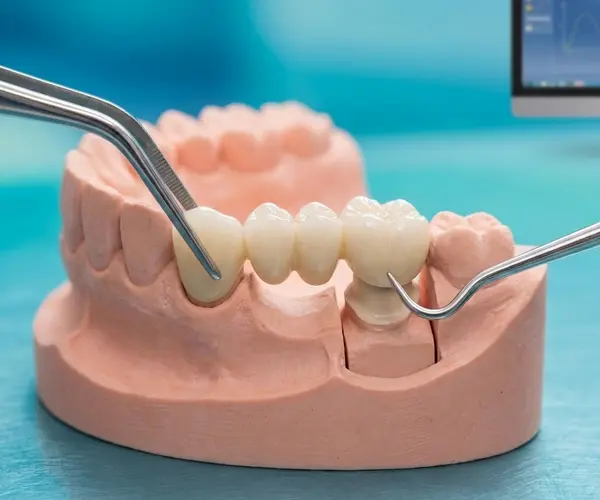
Types of Dental Bridges
Traditional Bridges
Among fixed dental prostheses, the traditional bridge remains the most frequently indicated solution for single-tooth replacement when sound abutment teeth are present bilaterally. At Fairfax Dentist, this restorative approach involves preparing the adjacent natural teeth to receive full-coverage crowns, which serve as supporting abutments. Fused between these crowns are one or more pontics—artificial teeth engineered to replicate the form and function of the missing dentition. The entire assembly is then cemented as a fixed unit, providing stable occlusion, preventing adjacent tooth migration, and delivering durable, esthetic results.
Cantilever Bridges
In cases where a missing tooth is bordered by only one sound abutment, a cantilever fixed dental prosthesis offers a viable restorative alternative. This design parallels that of a traditional bridge, with a pontic attached to a full-coverage crown—but with the distinction that the crown is cemented to a solitary abutment rather than two. While cantilever bridges are less frequently indicated than conventional bridges, they serve an essential role when bilateral abutment support is unavailable, providing effective functional and esthetic rehabilitation with a single anchoring tooth.
Maryland Bridges
Resin-bonded bridges—commonly referred to as Maryland bridges—represent a conservative prosthodontic alternative when adjacent teeth are sound and intact. Unlike traditional fixed bridges, this design requires no crown preparation of the abutment teeth. Instead, the pontic is supported by a metal or porcelain framework, featuring wing-like extensions that are adhesively bonded to the lingual surfaces of the neighboring teeth using high-strength resin cement. This approach preserves maximum healthy tooth structure while effectively restoring the edentulous space with a natural-looking, minimally invasive solution.
Implant-Supported Dental Bridges
When multiple adjacent teeth are missing and natural teeth can’t support a traditional bridge, implant-supported bridges step in as the superior alternative. Titanium implants are surgically placed in the jawbone to serve as artificial roots, providing a sturdy anchor for the bridge. Pontics are then attached to these implants via abutments, creating a stable, durable restoration. This approach not only preserves neighboring teeth but also prevents bone loss in the jaw—offering long-term functional and structural benefits that traditional bridges can’t match.
Benefits of Dental Bridges
Restored Functionality
Dental bridges do more than fill gaps—they restore the full functionality of your mouth. With missing teeth replaced, chewing and biting become comfortable and efficient once again, allowing you to enjoy a wide variety of foods without restriction. At the same time, bridges maintain the alignment of your remaining teeth, preventing unwanted shifting and bite problems. It’s a simple, effective solution that improves both daily comfort and long-term oral health. Call us today to find out if a bridge is right for you.
Enhanced Aesthetics
Beyond their functional utility, dental bridges are integral to facial and dental esthetics. Untreated edentulous spaces can compromise facial support, often resulting in a prematurely aged or hollowed midface appearance. Fixed bridge prostheses effectively counteract this by restoring alveolar contour and labial support through precisely fabricated pontics. These artificial teeth are meticulously matched to adjacent dentition in hue, surface texture, and incisal translucency, achieving an esthetic integration that is virtually indistinguishable from natural teeth. The outcome is a revitalized smile that harmonizes with facial features and enhances overall appearance.
Preservation of Oral Health
Beyond their restorative and esthetic functions, dental bridges play a significant role in preserving long-term oral health. By occupying edentulous spaces, they prevent mesial drift and supraeruption of adjacent teeth—conditions that can disrupt occlusal harmony and predispose patients to periodontal pathology, caries, and temporomandibular dysfunction. Furthermore, bridges promote balanced force distribution across the dental arch, reducing focal stress concentrations that contribute to accelerated enamel wear and structural fatigue. This makes them a vital component of comprehensive, preventive dental care.
Improved Speech and Confidence
Missing teeth can do more than affect your appearance—they can compromise your speech clarity and undermine your confidence in social settings. Dental bridges restore proper tooth alignment and provide essential support for your lips and cheeks, allowing you to speak clearly and naturally. With a complete, functional smile, you’ll feel more self-assured in every conversation, making social interactions more enjoyable and your overall quality of life that much brighter.
Durability
Dental bridges are engineered for exceptional longevity, fabricated from biocompatible, high-strength materials including dental-grade porcelain, noble metal alloys, or advanced ceramic-metal combinations. These prostheses are designed to resist occlusal wear, fracture, and corrosion under normal masticatory function. To optimize their service life, patients are advised to adhere to a regimen of regular recall examinations and meticulous plaque control. With appropriate maintenance, bridges offer a predictable, durable solution that preserves both function and esthetics over the long term.
Contact Us Today
Fairfax Dentist offers dental care & Invisalign® to patients in Fairfax, Vienna, Falls Church, Virginia.
Free consultation for first-time patients!