
Dental Implants in Fairfax, VA
At Fairfax Dentist, we restore full smiles with permanent dental implants.
Dental Implants: Benefits
Appearance is often the primary motivator for patients seeking dental implants—and understandably so. A gap in your smile can affect your confidence, while a precisely matched prosthetic restores harmony so convincingly that detection is virtually impossible.
That said, the advantages extend well beyond cosmetics. Missing teeth disrupt normal chewing mechanics, often causing patients to alter their bite or favor one side of their mouth. These compensatory patterns can result in temporomandibular strain, discomfort, and progressive joint damage. By restoring full occlusal function, implants allow you to chew naturally and comfortably, safeguarding your long-term oral health.
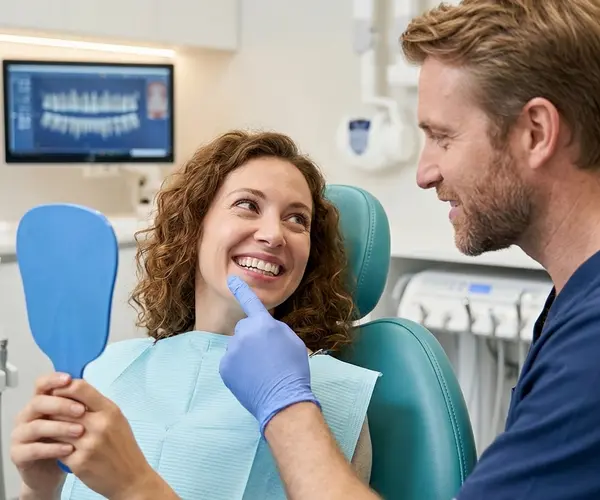
A confident smile
As dental professionals, we don’t just treat teeth—we build relationships rooted in trust and quality care.
Missing teeth can mess with more than your smile—they can affect your speech too. That lisp or slur you developed? An implant can fix that by giving your tongue the support it needs.
And the structural benefits are just as important. Your teeth drift. Your jaw weakens. Your face can even take on a sunken, older appearance. But an implant stops all of that—keeping your teeth aligned, your bone strong, and your face looking youthful. It’s a complete solution for your smile, your speech, and your long-term health.
Dental implants procedure
The journey to a new smile typically unfolds over two visits, scheduled several months apart to allow for proper healing. During your initial procedure, your dentist administers a local anesthetic to ensure your complete comfort before beginning the surgical phase. This involves gently opening the gum tissue to access the jawbone, where a precise channel is carefully created to anchor the implant post.
This post is set deeply into the bone to replicate the natural root structure of a tooth. While this titanium anchor integrates with your jaw, you won’t leave with a gap—a custom temporary restoration is placed on top, so you can eat, speak, and smile with confidence while your permanent crown is being prepared.
Dental Implants Results
A few months post-surgery, you’ll return for the final step. After confirming that your gums are healthy and the implant is firmly anchored in the bone, your dentist attaches an abutment and a connecting screw to secure your new tooth. The crowning moment? Choosing a prosthetic that’s custom-matched to your natural teeth—in size, shape, and color—so that once it’s in place, no one will ever know it wasn’t always there.
Why do adults lose teeth?
At our practice, we most often trace it back to one of these four factors:
Gum disease (Periodontitis)
Advanced periodontitis eats away at the bone supporting your teeth, causing them to loosen and fall out.
Injury
Severe trauma to the face can knock teeth out or damage them beyond saving, often leading to extraction and implant placement.
Diet deficiencies
Without enough vitamin D, C, calcium, and potassium, your teeth become brittle and prone to decay—and decay can lead to loss.
Chronic illness
Conditions like diabetes, high blood pressure, and rheumatoid arthritis raise your risk of losing teeth.
No matter the cause, the most important step is the same: replacing the missing tooth. Dental implants work for nearly every case of tooth loss. And if gum disease was the root issue, we encourage you to combine implant treatment with periodontal care at Fairfax Dentist to safeguard your smile for the long haul.
Dental Implants Alternatives & Preparatory Procedures
Not every patient is an immediate candidate for dental implants. If your jawbone lacks sufficient density or volume to securely anchor the post, your dentist may suggest a preparatory procedure called bone grafting. This involves taking bone from another site—often from your own body or a donor source—and transplanting it to the affected area, creating a stronger, more stable foundation for the implant down the line.
It’s also worth noting that implants aren’t the only tool in our restorative toolkit. During your consultation at Frfax Dentist, our dentists will evaluate your unique oral anatomy and may recommend an alternative approach that better suits your specific needs. For instance, if you’re missing several adjacent teeth, an implant-supported bridge often provides a more practical and cost-effective solution than placing individual implants for each gap.
Dental Implants FAQs
What is the longevity of dental implants?
Dental implants are engineered as a durable, long-term prosthodontic solution. With appropriate maintenance, they demonstrate a clinical survival rate exceeding 20 years, with many cases extending throughout the patient’s lifetime. The endosseous titanium post provides exceptional stability through osseointegration. Nevertheless, the prosthetic crown is susceptible to functional wear and typically requires replacement after 10 or more years of service. Maximizing implant longevity necessitates adherence to a rigorous home-care regimen, regular periodontal evaluations, and avoidance of parafunctional habits and smoking.
How long does it take to recover from dental implants?
Recovery duration is influenced by the number of implants placed, your general health, and whether adjunctive procedures like bone grafting were performed. Initial healing typically spans one to two weeks, accompanied by mild swelling and discomfort. Complete osseointegration—the fusion of the implant with the jawbone—requires three to six months, after which the final restoration is affixed. While most patients resume normal activities within days, full functional capacity may not be achieved for several months.
Is there insurance coverage for dental implants?
Coverage varies significantly by insurance provider and plan. Many dental policies cover associated components—such as the crown, abutment, and diagnostic imaging—but exclude the surgical placement of the implant itself. Medical insurance may offer partial reimbursement when tooth loss results from trauma or a qualifying medical condition. During your consultation, we’ll provide a personalized cost estimate based on your benefits and discuss available financing options to bridge any gaps.
Are there any risks with dental implants?
Dental implant surgery enjoys a favorable safety profile, particularly when performed by clinicians with advanced training and experience. As with any invasive procedure, however, there are inherent, albeit modest, risks—including postoperative infection, neurovascular compromise, and failure of osseointegration. These complications are statistically rare and can be effectively mitigated through comprehensive preoperative assessment, precise surgical technique, rigorous oral hygiene, and strict compliance with post-surgical care regimens.
Can smokers still get implants?
The short answer is yes—but with important caveats. Smoking reduces blood flow to the gums, which can delay healing and raise the risk of infection or implant failure. Smokers do face higher odds of complications, but that doesn’t mean implants are off the table. The key variable? Your willingness to quit. Patients who stop smoking before surgery and stay smoke-free during recovery see significantly better results. If you’re a smoker considering implants, having an upfront conversation with your dentist is the first and most important step toward a treatment plan designed for success.
What Are Mini Dental Implants—and Are They Right for You?
Mini dental implants are characterized by a narrower diameter relative to standard endosseous implants and are commonly employed in cases presenting with insufficient alveolar bone volume. Their principal indications include prosthetic stabilization of removable dentures and replacement of mandibular or maxillary incisors. Although they offer distinct advantages—including minimized surgical morbidity and accelerated healing timelines—they are generally contraindicated for molar substitution or as support for complex fixed prostheses. Appropriate candidates include edentulous or partially edentulous patients with diminished bone density, as well as those desiring an expedited, more cost-effective treatment modality.
Implants vs. Dentures: Which Path Is Right for You?
This is one of the most personal decisions you’ll make—and we’re here to guide you every step of the way. Dental implants offer unmatched stability, natural chewing power, and the important benefit of preserving your jawbone over time. They won’t slip, shift, or require messy adhesives like dentures often do. On the other hand, dentures are generally more affordable upfront and can be a practical choice if you’re on a tighter budget or have health concerns that make surgery less appealing. There’s no one-size-fits-all answer—it really comes down to your oral health, lifestyle, and financial goals. During a consultation, we’ll sit down with you, explore your options, and help you find the solution that feels right for your smile and your life.
Our Patients Are Saying
Lacey Duvall
“After childhood cancer treatment, my teeth became brittle and prone to breakage. When I finally met my surgeon, he listened to my wishes and performed dental implants. Now my life has changed dramatically, my smile is restored, and I finally feel like I have a world at my feet.”
Paul B.
“As a child, I suffered a traumatic accident that left me with crowns on my front teeth, and over the years, my teeth only got worse. I was skeptical at first, but after reading positive reviews from others, I scheduled a consultation. Honestly, I’m so glad I did. The surgery went great. Now I enjoy smiling again and seeing my friends’ reactions.”
Helen Rice
“I turned to Dr. Barnhart after being turned down by several dentists in the US due to significant bone loss. When he offered me a treatment plan that included implants, I was overjoyed. I had come a long way to get full-arch dental implants with a zirconium bridge, and in just four days, I felt like a completely different person.”
Contact Us Today
Fairfax Dentist offers dental care & Invisalign® to patients in Fairfax, Vienna, Falls Church, Virginia.
Free consultation for first-time patients!